
A few years back, I was DM-ing D&D 5e for a group of friends and we were looking for a long, complex campaign with mystery, intrigue, combat, threats of Armageddon… and character development. My preference is for homebrewed worlds – deities, nations, cities, NPCs – and all the history that goes with it. I had never run a published module and had no intention of doing so in this case. Thus was born a campaign we titled Kol t’chapa Rising.
Since many DMs/GMs are similarly interested in their own world-building, I’m going to share how I approached it.
As I have said in other posts before now, I don’t believe there’s One True Way(™) of building a campaign, and so my experience should not be taken as such. But if it gives you inspiration to build your own, then it’s worth sharing.
My approach tends to be a bit of an ever expanding development. Add a bit to column A, then to column B, then C, then back to expanding A, and so on.
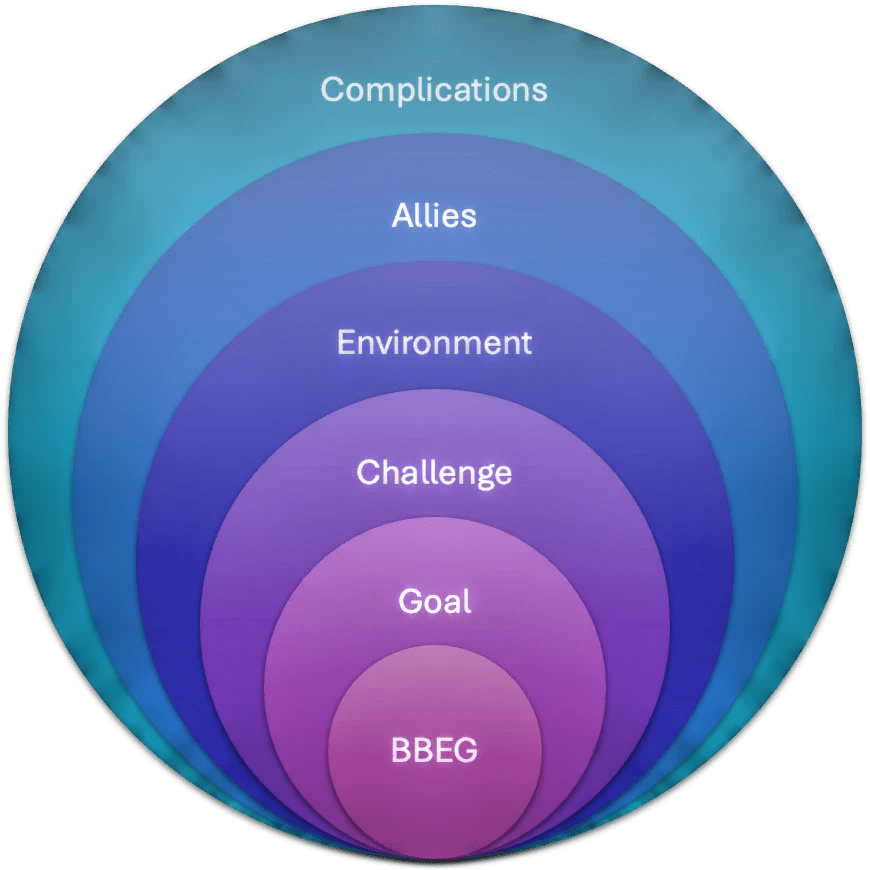
I started with a BBEG (Big Bad Evil Guy/Gal) – who are they and what do they want?
In my case, I knew I wanted a powerful, demon-worshipping wizard trying to summon a demon army. Hardly unique, but it’s something the players would recognize as being important to stop. I’m not one to shy away from fantasy tropes – they’re highly valuable. It’s the unique details we add that are important.
Of course, there must be something this wizard needs to succeed, otherwise it would already be done by now. In my case, I came up with three demon orbs necessary to open a gate to the Abyss. But there needs to be a challenge. Why doesn’t the wizard have them now?
So I…
Wait.
I needed to name this wizard.
I had found a great picture online of a female elf wizard and decided it was her. She just needed a name. I don’t usually find online name generators perfect, but they can certainly provide inspiration. After some playing around and some thought, I had it – Serisse Eilmaris.
Back to the challenge. So why doesn’t Serisse have the orbs now?
I decided they were used in the distant past and the victorious powers of good, unable to destroy them, hid them away. I like the idea of alliances between races – probably from my love of Tolkien and the Last Alliance of Men and Elves or the Battle of Five Armies – and so the agents of the dwarves, men, and hobgoblins who defeated the demon horde took these orbs and hid them away, protected by many wards.
The orbs’ indestructibility was important, otherwise all the players would need is to find and destroy one and Serisse’s whole plan is scuttled. That’s often a problem I find with “collect all the keys” adventures. The entire adventure can be short-circuited and probably should be. For my case, as long as the orbs exist, even in the PCs’ possession, she would be after them. And, since they can’t destroy them…
With my BBEG and her goal and challenges identified, I then start building the world around her by asking questions:
- Where does Serisse live?
- Does anyone know Serisse is evil and has an evil plot?
- Where might the PCs come from?
- What other powers exist in the world?
Answering those questions allowed me to put together a number of major cities, each of which were associated through a confederacy. I gave each city a theme – arts for one, spirituality for another, trade for a third, and arcane knowledge for a fourth. This then gave the players opportunities for building out their backstories, with the bard being raised in the city of arts, the arcane trickster attending school in the arcane city, etc.
I decided the identity of the BBEG should remain a mystery for some time, so I made her a seemingly beneficent politician in one of the cities. That ensured the PCs would learn about her early but not recognize her true nature and intentions until much later.
Finally, I created a bare minimum number of deities. One player indicated a desire to play a druid, so I made sure there was at least one option for them. The others were of the type most likely necessary for the civilization I was building – one for light and life, one for war, one for knowledge. I could add more as my players asked about them or the story drove a need for them. I really didn’t want to spend too much time on things that wouldn’t be useful.
I then went back to expand upon earlier decisions.
- Who are Serisse’s allies?
- What complications is she currently facing?
- Who are potential allies for the PCs?
Since Serisse was “undercover”, she needed agents hunting down the orbs. I identified who they were and who their helpers were.
As to complications, her agents were likely stirring up trouble in certain circles and it seemed most interesting for those to be potential allies to my PCs (potential but not current – i.e., I embedded additional challenges in the main plot structure).
I decided my hobgoblin nation was more like the Klingons from Star Trek rather than the typical brutes. These were powerful and intelligent with a strong streak of honor and respect for strength. And they had recognized that someone was trying to find the orb that their ancestors were charged with protecting!
This set a complication for the PCs, as relations between the hobgoblins and the confederacy had become quite poor.
I also determined the dwarves had been rather insular, and so the knowledge of their orb was also going to be a challenge to discover.
Finally, before we could start the campaign, I decided where Serisse planned to combine the orbs and open the gate, should her plans succeed. This was revisiting her goal to add details.
I figured the original gate was built on an ancient mountain – Kol t’chapa1 – that had been destroyed at the culmination of the previous, long-forgotten war and sunk. Serisse would use the power of the orbs to raise Kol t’chapa from the depths, reopen the gate, and summon her demon master.
And that was pretty much it.
The players started with very small missions designed to acquaint them with some of the people and locations, but not strongly linked to Serisse. I let their explorations determine when to create additional plot hooks (ask me about the red candles) and the campaign grew organically from there. Whether or not they got involved with any particular plot points, I knew what Serisse was trying to accomplish, what stood in her way, and could determine how things might change based on the PCs actions (or lack thereof).
In the end, they went from levels 1 to 14 and each of them had major backstory developments that became entwined in the main plot but didn’t start out that way. Two of the players played half-brother half-orcs, one of whom briefly became clan chief before abdicating to focus on stopping Serisse. Another – the rogue – was briefly captured by Serisse and later discovered his mentor was in league with Serisse but also planned to betray her for his own evil purposes. The other, the bard, discovered the identities of his real parents, with his biological father sacrificing his own life to save his son, and also having the entire party treated to a home-cooked meal by his adoptive parents.
Further, since they wanted to experience reaching level 20, those same PCs closed some remaining threads after defeating Serisse in an epic battle, and put a nice bow on the entire campaign.
Conclusion
While there are many ways to approach a large-scale campaign, I find building out from the BBEG and that individual’s goals to then add enough detail to get going really helps to establish a living world in which you don’t get stuck railroading the PCs, while still having the essence of a changing environment where decisions matter.
Let me know if you have other methods that can help GMs build their own campaign worlds.
- Every fantasy world needs at least one name with unnecessary punctuation ↩︎



 Gypsywagon Gaming
Leave a comment