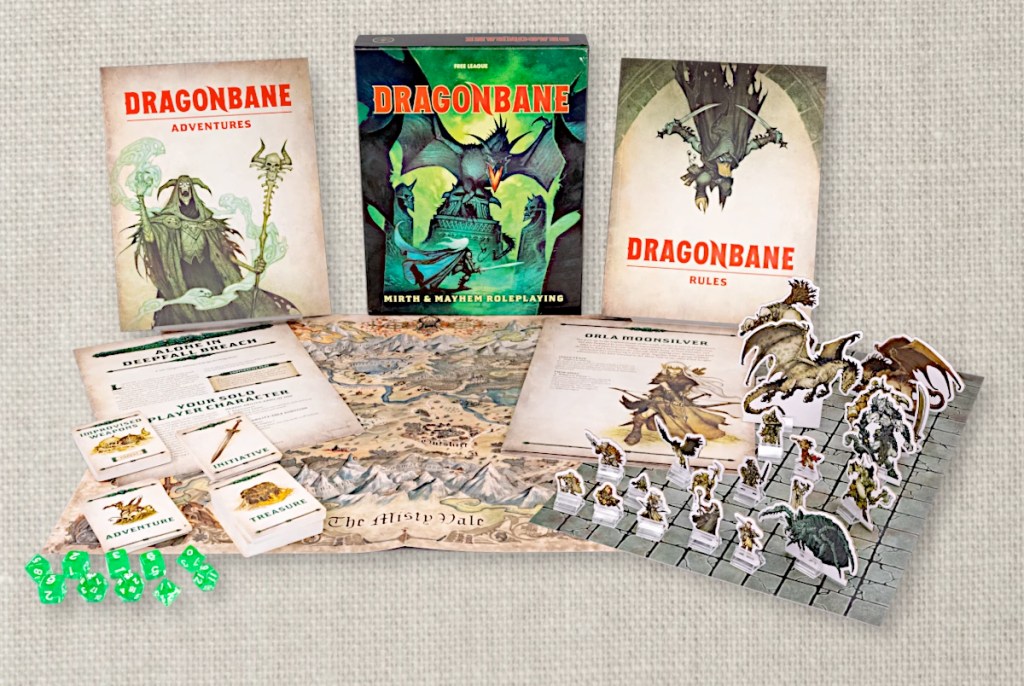
What is Dragonbane?
Produced by Free League Publishing (Fria Ligan), Dragonbane uses a classic Fantasy RPG design that recognizes its roots in the original 1982 Swedish version called Drakar och Demoner (Dragons and Demons). It came into my field of vision thanks to a great Humble Bundle offer of Free League titles at the end of 2024.
Presentation
Before I get into the technical details, I want to discuss the presentation of the rules themselves. Some RPGs are poorly laid out, difficult to read, or otherwise off-putting. Dragonbane is none of those.
Art appreciation is quite subjective, but I love the artwork in this game! There’s a dark fairy tale quality to it that draws me in. I honestly cringe at many of the animal folk in D&D but somehow having a mallard and a wolfkin option in Dragonbane feels right. It feels fun.
I also found it easy to perform a PC build using the guidelines provided. The book’s structure pulled me from chapter to chapter and section to section, getting a playable character built in no time. Oh, and pre-generated characters are provided along with character sheets. This is something I really appreciate, as the pre-gens help me understand what the authors consider important to note on the sheet. I really wish every RPG author would do the same.
How does it work?
Dragonbane is a d20 system, meaning the vast majority of checks for success or failure uses the 20-sided dice normally found in modern RPGs. The game does present a bit of flavor by referring to a Natural 1 (NAT-1) and Natural 20 (NAT-20) as a Dragon and a Demon, respectively. Just like in many other RPGs, this signifies either an exceptional success or failure.
It also uses a Roll Under system, which is new to me but maybe not to a lot of other gamers. Essentially, you’re trying to roll under some number rather than over, meaning low rolls are good, with a Dragon (NAT-1) best of all and a Demon (NAT-20) signifying that something bad is about to happen.
Character design includes the selection of Kin (race, ancestry, or species in other RPGs) and Profession (the Dragonbane version of a Class), as well as the rolling for six key attributes: Strength, Constitution, Agility, Intelligence, Willpower, and Charisma. These should be familiar to anyone that has played any of the majority of FRPGs. Hit Points are used to reflect damage absorption and Willpower Points used to power various capabilities, such as magic spells.
Since FRPGs often revolve around combat, the combat system is critical to how the game will play at the table. In Dragonbane’s case, it’s a recognizable system of initiative and attack rolls, but there are some interesting differences for those coming from D&D, namely:
- Rather than rolling for initiative and dealing with tie scores, cards are drawn from a range of 1-10 (Ace-Ten, if using standard playing cards) with low number going first.
- Cards are collected, shuffled, and redrawn after each round.
- Characters only get one action and move (which can be split around the action), though there are free actions for simple things.
- Attacks use the previously mentioned roll under system using the attacker’s weapon skill number rather than any comparison against a target’s AC. Rather, the AC simply provides some degree of damage absorption.
- Monsters ALWAYS hit – there’s no attack roll for them, just a random roll to determine what kind of attack they make. Particularly strong monsters get multiple initiative cards to get multiple attacks.
- Avoiding a hit requires using an untaken action to attempt a dodge or parry. If you already used your action in the round, it is not available to you.
- When your turn arrives, you can choose to swap with someone else in the turn order, essentially delaying your own turn but also putting that other player, NPC, or monster up into your initial slot.
Another mechanism I really like is the optional Pushing your Roll. If you fail a check, you can reroll at the cost of a condition that applies a Bane (Disadvantage) on all subsequent rolls using the affected attribute. Used properly, this can really improve your chances of survival, or at least successfully driving the action forward.
So what does all this mean for playability?
While the single action seems like it would be limiting, it actually encourages a different set of tactics to combat. Should you let the enemy attack your tank first, hoping to either absorb or dodge the attack and then let everyone else go with no fear of reprisal this round? Do you want to put your spellcaster first to soften the enemy with a fireball and then get the heck out of Dodge?
Like many RPGs out now, if you approach Dragonbane combat like it’s D&D combat, you’ll probably end up sad and your PCs dead, but if you take the time to learn and lean into the team-nature of the problem, you should have a good time. These action limits can speed up combat, as can the deadly nature of Dragonbane combat.
Why, you ask?
Character progression is not level-based. Your HP doesn’t explode to god-like proportions just by slaying some monsters. A sword thrust can kill anyone – if it lands. Progression, instead, is based on improving skills and gaining new Heroic Abilities. Every time you roll a Dragon or a Demon on a skill check, you can mark that skill for an advancement check at the end of the session. Even if the dice don’t fall in your favor, just by engaging in the game and driving the story forward you will earn you a few advancement checks. Roll a d20 for every earned check and, if you roll HIGHER than your current score, you can bump it up. This means that it’s easier to advance a skill you’re weak in rather than one you’re already excellent in. So try exercising some of those weak skills!
Table Thoughts
I just recently got this game to the table. While I had read the rulebook ahead of time, focusing on character creation, skill checks, combat, and death and healing, only one other player had a chance to glance at the rules. The other two didn’t even know we were going to play it that night! We used the provided pre-generated characters (Pre-Gens) and I used Matt Colville’s Delian Tomb idea and immediately got to it.
The session went surprisingly smooth. There were a few rule lookups we had to do, and at times we went with what seemed logical, promising to look up the actual rule afterward. It helped that all the players had played D&D before and at least one other had familiarity with some different RPGs. That meant our assumptions were also valid, but that’s a credit to the authors for sticking to tried and true gaming practices. Not everything has to be novel and new. It just has to be fun.
I mostly enjoyed using the provided character sheets, but I did find I had a problem with the attribute entries. When I’m focusing on the lower part of the sheet, which is most of the time, and then scan up to see my attributes, by eyes get caught on the conditions and it takes me extra time to find and refocus on the attribute headings. Having those headings more pronounced – perhaps bolded or otherwise highlighted would help. I expect to get accustomed to the layout over time, but I did get mildly frustrated with myself.
As to lore, the rulebooks provide a minor bit of background about the ancient struggle between dragons and demons and the rise of the other kin, but it’s a very light hand. It provides inspiration if you want to build upon it, but it’s not an anchor to tie you down. As someone who prefers to homebrew my worlds and adventures, I appreciate the limited information provided.
We’ll be playing a few more sessions with Dragonbane before we experiment with something else. My first impression, though, is very positive, and I think I might like to try it for a longer term campaign, especially given some high quality modules, like Path of Glory. There’s a Foundry VTT option, too, for those leveraging online tools for their games.
If you are trying to move away from the Hasbro/WotC behemoth that is D&D 5e and the continued decline of a once-great RPG, you can snag the digital version of the Dragonbane rules from DTRPG or the physical copy from Amazon if you want to check them out. I’ve seen rumors that an Expert add-on and a Magic add-on may be coming, possibly through one or more KickStarter campaigns, so keep an eye out for that. I believe we’re looking at more Profession options plus lots more spells and schools of magic beyond Animism, Elementalism, and Mentalism.
It’s a great time to consider alternative RPGs to scratch your roleplaying itch.



 Gypsywagon Gaming
Leave a comment