When I first started looking for an alternative to D&D, the most natural direction to look was Pathfinder. My group had some familiarity with it, knowing it as a fork from D&D 3.5, and I figured it would be similar enough to what they already knew. Furthermore, the second edition of Pathfinder had been out for a bit and many gamers called it a mathematically tight game with good balance and a stronger encounter challenge system than D&D.
What’s not to love?
Well, by the time I got a group willing to try it (with help from a friend who was also interested in 2e, having played some 1e before), the Remastered version of Pathfinder 2e (PF2e) had been published, following the whole Open Gaming License (OGL) debacle by Wizards of the Coast. Wanting to support creators, I spent some coin on the whole set of remastered books, both physical and digital: Player Core, Player Core 2, and GM Core. I only got the digital version of Monster Core, since that’s easier for me to use in our online gaming sessions.
I went further, though, and also invested in a Foundry VTT setup on The Forge, and bought the Blood Lords and Abomination Vaults Adventure Paths. In for a copper, in for a gold.
Now that we have a bit of play under our belts, I thought I would write up my thoughts on the system. I won’t be reviewing the Adventure Paths (we decided to go with Abomination Vaults) and will only slightly refer to the Foundry VTT experience (which is awesome).
The Review
Any consideration of a game starts with character creation. By walking through the character creation process, you can quickly discern important elements of the game that you’ll need to learn for play. In the case of PF2e, there’s a lot of recognizable stuff – six attributes that produce modifiers: Strength, Dexterity, Constitution, Intelligence, Wisdom, and Charisma. Skills. Feats. Hit Points. Armor Class. All the usual. Well, most of the usual.
Right off the bat, I noticed a pleasant surprise: In the PF2e Remaster, they did away with the actual attribute scores (3-18) and just listed the attribute modifiers. Generally the actual score is meaningless (except for a few esoteric capabilities like jump distance) and those edge cases are easily replaced. I think any time you can get rid of complexities that don’t serve game play, you should.
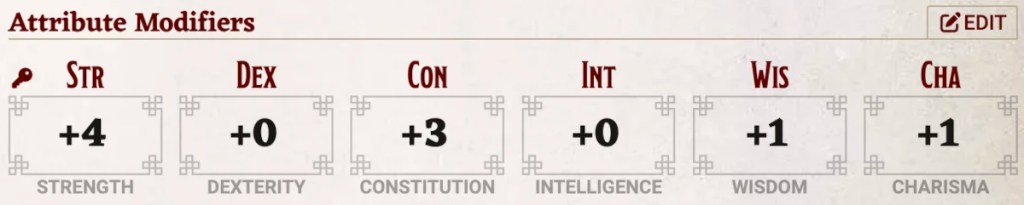
Unlike some other systems, PF2e does not have you roll for these attribute modifiers. Instead, you get them from your selections of ancestry (i.e., race or species), heritages (i.e., subrace), background, and class. In some cases, you are directed which modifier you get in a particular attribute; in others you have free choice. By removing the rolls for attribute modifiers and moving to a common number of selections, characters should be reasonably balanced, preventing the party from being dominated by one or two min-maxers.
Since my review isn’t intended to teach you how to play PF2e – there are already a ton of excellent resources online for doing so – I’ll leave it there. The process is similar enough to D&D that the general idea is easy to pick up. There are, however, a lot of options, which can be daunting. I imagine a newcomer to D&D will find the same, but I’ve been playing it long enough that character creation seems easier there. I’m sure that’s my bias. If you’re coming from D&D, you may experience the same.
From a player perspective, the biggest thing to deal with is the action economy – the number and type of mechanical actions a player character (PC) can take. There are actions (and associated skill checks) for encounters, exploration, and downtime. Since my group, and probably many others like it, are interested in combat, it’s the encounter action economy that we’re most concerned with in this review.
In PF2e, there are three actions per PC per turn and those actions can be pretty much anything – moves, attacks, spells, etc. Some things cost more than one action (such as most spells), but at the end of the day you have three to work with, which allows for a great deal more strategic thinking. On the downside, it also requires considerably more strategic thinking (see what I did there?).
Coming from a D&D background, the idea of taking three attacks per round sounds great. But PF2e introduces a Multiple Attack Penalty (MAP) that makes each attack progressively worse after the first, so that a third attack is almost always your worst choice, strategically. This can present a challenge to folks coming from D&D, where teamwork is far less necessary. PF2e design encourages more collaboration, by spending actions on things that help the team. Yes, this includes a nice juicy attack roll, but it also means pointing out an enemy’s weaknesses or causing a distraction that can improve a chance to hit.
Oh, and combat is much deadlier than D&D if you don’t play a strategically sound game. D&D’s idea of bounded accuracy doesn’t exist here. Armor class and difficulty ratings continue to climb, as do the PCs’ offensive skills. There are also degrees of success or failure, such that critical successes and failures are more common, bonuses to attacks are far more influential, and many a successful save still causes damage.
And that brings me to healing. A simple night’s rest doesn’t magically heal a player on death’s door. In-combat healing, because of how much damage can be dealt, is almost a must have, and magical healing is crucial. Our first level PCs in one battle had two members of the party reach an unconscious and dying condition multiple times and only magical healing prevented a TPK. They actually defeated the monster when, after the very first attack, it looked like a TPK was coming quickly.

Bottom line: make sure at least one PC has good healing capabilities!
Encounters are far more complicated than D&D. Reactive Strikes (i.e., Attacks of Opportunity) are not something every PC and creature can do, so a moving, dynamic battlefield is much easier to pull off – making for a more interesting encounter. But there’s just so much more you can, and should, do to be victorious. Personally, I find this a lot of fun. If you prefer the simplicity of D&D combat, though, this might not be for you.
Because of this complexity, playing at a physical table may be challenging without the use of digital tools. Between attribute modifiers, temporary and permanent conditions, proficiency bonuses, circumstance bonuses, status bonuses, and item bonuses, there’s a lot of things that have to be identified and added to the die roll to determine success or failure. Using a VTT like Foundry, all of this is automated on the character sheet. Likewise, there are other digital character sheets (Pathfinder Nexus, Pathbuilder) that can handle much of this for you. I don’t think I would attempt to play this at a physical table with paper, pencils, and plastic dice.
Another aspect of PF2e to consider is the setting. Many RPGs come with a baked-in world and PF2e is no different. In fact, the world of Golarion is extremely built out as to lore, ancestries, politics, religions, etc. You have undead nations, ascension to godhood, and space alien elves. There are novels and comics and videos that build on all of this lore, not unlike the Forgotten Realms and other settings for D&D. If you want a full, rich world to play in, PF2e has you covered.
If you’re like me, though, and like to build your own worlds, Golarion is something better left by the wayside. It tries to be too many things to too many people. Even in a world of magic, the logic of the place is just difficult for me to swallow. To support clerics and other deity-adjacent PCs, you will want to develop your own pantheon and include a number of details that the character rules leverage, such as edicts and anathema, which can provide a sort of “do/don’t do” list that must be followed to avoid penalties.
Conclusion
And so, to me, Pathfinder Second Edition is absolutely a better experience than D&D, but there’s definitely a learning curve to it and some work to do as both a player and a GM to really get comfortable with the system. It is by no means an easy system, but there are some great design elements like the 3-Action Economy and expanded crit ranges that make combat encounters far more interesting. Another key factor in deciding to play it is that the rules are completely free. Using a resource like the Archives of Nethys, you can learn all there is to know about playing PF2e (except the lore) without spending a dime.
While I am gravitating toward a lighter rules experience for much of my play, I do think PF2e has a lot going for it if you’re into crunchy, tactical combat plus a lot of rules for other parts of the role playing experience.



 Gypsywagon Gaming
Leave a comment