When I received my Free League Publishing Humble Bundle back in November of 2024, I did not realize how hooked I would be on their releases. Having played D&D for decades, the various rulesets and beautiful art really made me want to dive into every book and bring them to the table. But you know having the time and the players to do that is a very rare thing, indeed.
Well, I now have a group willing to experiment (though time is still an insurmountable barrier to playing them all NOW). We’ve been playing Dragonbane for a couple sessions and starting to think about the next game to try. And so I’ve been looking through my digital library (and I now have hard copy versions of many) to get a sense of what we should try.
There were quite a few titles in the Bundle, but three of them fall clearly into the Fantasy RPG category and, since that’s what I’ve played most of my life, where we’ll stay for a few more months. I do want to branch out to other genres but, since we’re a new group, learning a new genre can wait while we work through Tuckman’s team dynamics.
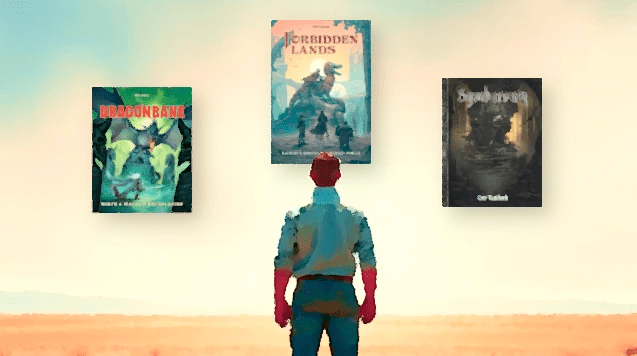
I’ve started writing up notes comparing and contrasting the three systems: Dragonbane, Forbidden Lands, and Symbaroum, and figured I’d share those here for anyone else considering these three systems.
I will, of course, caveat my notes saying that I’ve only actually played (GM’ed) Dragonbane and only for a couple sessions. Hopefully, in a few months, I’ll be able to write up some after action reports that should reveal how they actually worked for us. I don’t profess to be able to fully understand how a rule will work at the table until we actually use it. I suppose that’s what play testing is for – predictions are hard.
Let’s get into it, then, with one more caveat: Symbaroum has an Advanced Player’s Guide that provides even more options. For this process I am not using this, focusing on just core rulebooks for each. We’ll be keeping it simple for our first foray into each game.
Character Creation
Having done the Character Creation Challenge in January, I did get to go through the chargen process for each of these games. Rather than discuss the process, I just want to profile how characters “work”.
Dragonbane and Forbidden Lands use the concept of Kin while Symbaroum still uses the term Race, but they work the same.
- Dragonbane Kin: Human, Halfling, Dwarf, Elf, Mallard, Wolfkin
- Forbidden Lands Kin: Human, Elf, Half-elf, Dwarf, Halfling, Wolfkin, Orc, Goblin
- Symbaroum Races: Human, Changeling, Ogre, Goblin
Dragonbane and Forbidden Lands, again, use the same terms for what we normally consider to be a Class – Profession. Symbaroum uses Archetypes to express the same thing, with Occupations acting as sub-classes.
- Dragonbane Professions: Artisan, Bard, Fighter, Hunter, Knight, Mage, Mariner, Merchant, Scholar, Thief
- Forbidden Lands Professions: Druid, Fighter, Hunter, Minstrel, Peddler, Rider, Rogue, Sorcerer
- Symbaroum Archetypes (and Occupations): Warrior (Berserker, Duelist, Captain, Sellsword, Knight), Mystic (Witch, Sorcerer, Theurg, Wizard, Self-taught), Rogue (Charlatan, Witchhunter, Thug, Treasure-hunter, Ranger)
The mechanics of a character starts with some numerical measures of various facets and are typically referred to as Attributes. All three systems use this term, but express Attributes in different ways. I’ll go over the dice systems shortly.
- Dragonbane: Uses a common 6 Attribute system based on a 3-18 spread. They are: Strength, Constitution, Agility, Intelligence, Willpower, Charisma
- Forbidden Lands: Uses 4 Attributes that can range from 2-6 and are built using a pool of starting Attribute Points. The Attributes are: Strength, Agility, Wits, Empathy
- Symbaroum: Uses 8 Attributes that can range from 5-15 and may be selected from a predefined distribution or may be built using a pool of 80 points. The Attributes are: Accurate, Cunning, Discreet, Persuasive, Quick, Resolute, Strong, Vigilant
All three systems provide a more detailed set of character aspects to help you identify strengths and weaknesses. For Dragonbane and Forbidden Lands, the term Skills is used while Symbaroum uses Abilities. They represent the same concepts as Skills used in other RPGs. Further refinement of the character is made using Heroic Abilities(Dragonbane) or Talents (Forbidden Lands). These act like Feats in other RPGs. Note that I don’t see that Symbaroum has this further refinement.
The other thing I wanted to consider at the character level is related to resources. The concept of Hit Points has been with us for a very long time. It’s often a precious resource that lets us know how long our PC can go on. Each of these games have different mechanisms for providing and tracking precious resources.
Dragonbane has the standard Hit Points that let us know when death approaches. There’s also a Willpower Points pool that gets used to power magic spells and various Heroic Abilities.
Forbidden Lands has Willpower Points and the previously mentioned Attribute Points. Willpower Points must be earned in play and are used to power spells. Regarding Attributes, there are numerous activities, such as combat and spell effects, that can reduce Attribute Points temporarily. When an Attribute reaches 0, your PC is Broken and unable to continue. There’s also a concept of Pride that can be used once per session, so that certainly counts as a resource, but is a bit different.
Symbaroum has two resources: Toughness and Corruption. Toughness is synonymous with Hit Points. Corruption is… well, maybe it’s not accurate to call it a resource. It’s a thing that builds up on a character from spellcasting or certain confrontations and can cause harm. I’m going to leave it here since it’s something that needs consideration for play.
All three systems support spellcasting PCs.
- Dragonbane has three schools of magic: Animism, Elementalism, and Mentalism. As mentioned earlier, spells are powered by Willpower Points. Spend more points (Ranks) to make each spell more effective. There are no leveled spells, though there is a Cantrip equivalent called Magic Tricks. Unlike D&D, these are not very powerful, are pretty harmless, and can provide a lot of use for a clever player. Failing a spellcasting attempt badly (rolling a Demon, which will be covered later) can result in a magical mishap (optional rule).
- Forbidden Lands has two magic-using Archetypes: Druids and Sorcerers. Each Archetype has a number of disciplines that act like schools. Druids have Healing, Shapeshifting, and Awareness while Sorcerers have Symbolism, Stone Song, Blood Magic, and Death Magic. The system uses Ranks to indicate spell power and you must have a sufficient Rank in the appropriate Talent to cast a Ranked spell. Good rolls may Overcharge a spell (a good thing) and bad rolls may result in a Mishap (a bad thing). Finally, casting spells requires Willpower Points and… you start the game with none. Yes, you must do other things to earn them before you can cast spells. Hmmm.
- Symbaroum has five Mystical Traditions: Theurgy, Sorcery, Witchcraft, Wizardry, Independents (self-taught). As mentioned earlier, the use of mystic powers brings the risk of corruption. Mystical effects are based on the grade of the caster’s Mystical Power ability (Novice, Adept, Master).
Rounding out this assessment of characters is advancement. For each system, advancement is considered at the end of each session. None of these systems use a character level concept – you simply get better at certain things gradually over time.
In Dragonbane, during play, any critical successes (Dragons) or failures (Demons) are noted for each skill. There’s also a list of questions the GM will ask that may give players more advancement checks. For each check earned, the player attempts to roll higher than the current score in that skill. If successful, the skill score goes up by one.
Forbidden Lands and Symbaroum both use an Experience Point (XP) system that can be used to buy upgrades to skills, talents, or abilities.
Dice
Okay, let’s talk about the dice systems. Actually putting a player into practice means you’ll eventually interact with the mechanics of the game and that’s where the dice come in.
- Dragonbane: Based on the d20, players attempt to roll under their skill score to determine success. Because low is better, a natural 1 (Nat-1) is a particularly good outcome and is known as a Dragon. Likewise, a Nat-20 is a particularly bad outcome and is known as a Demon. As noted in character advancement, the rolling of either of these can give you a chance to upgrade the relevant skill at the end of the session. Failures, other than with a Demon, can often be Pushed (rerolled) but at the cost of taking on a Condition. Other dice from the standard polyhedral set are used in certain circumstances, such as dealing damage, but this is primarily a d20 system.
- Forbidden Lands: Success checks use dice pools of d6 dice, with Attribute scores, Skill scores, and Gear contributing to the number of d6 in the pool. There may be conditions and other effects that also impact the number of dice in the pool. Once the pool is rolled, any 6 counts as a success. Multiple 6s indicate the opportunity for increased effect. Ones may be detrimental, but typically only if you attempt to push your roll (try again but with a cost). These costs depend on which type of die resulted in a 1 (Attribute or Gear). Note, there are occasions where you will use a d8, d10, or d12, as well.
- Symbaroum: This system also uses a d20, roll under approach to determine success. Unlike the other two systems, Symbaroum regularly uses opposed rolls** to determine success. For passive challenges, these are basically Difficulty Class scores. You will also have use for the other dice in a common polyhedral set. **Edit: Technically, these rolls are modified by some opposing stat and not truly an opposed roll.
Game Design
Each of these games has a different theme. I probably can’t do justice to them in just a few sentences, but…
- Dragonbane seems to go for that Old School Renaissance (OSR) feel most familiar to players from a D&D background. This being the one I have already brought to the table, my experienced D&D players easily picked it up and started having fun. The book provides a very minimal setting so that homebrewers can play it in any world they want.
- Forbidden Lands is all about the hex crawl. Although the main book provides minimal world details, the Gamemaster’s Guide provides a lot of lore. The exploration rules are extensive, something disappointingly missing from most other D&D editions.
- Symbaroum provides a detailed setting and applies equal amounts of horror and adventure to the game. There are all sorts of factions to really expand on the roleplaying aspect, however the rules are primarily combat focused, so RP is more on the GM and players rather than the mechanical rules.
Miscellaneous
A few other items to note before wrapping this up.
In combat, Dragonbane and Forbidden Lands use initiative cards to ensure there are no ties, though you can certainly use other methods. For Dragonbane, you draw a new initiative each round, while Forbidden Lands remains the same initiative throughout. Symbaroum, on the other hand, uses a character’s Quick rating, with the Vigilant rating used as a tie-breaker and a d20 roll used if there’s still a tie.
Also, in Dragonbane characters roll a combat-related skill check to determine if they hit while AC only serves to reduce damage. There are options to Dodge or Parry, and those use your lone action per round. This makes in-round decision-making important. It also keeps things moving quickly. Oh, and monsters ALWAYs hit (barring the aforementioned Dodge) and the only question is what they do with their turn, which is rolled on a random table (1d6). This can add some variety and take the pressure off the GM.
Forbidden Lands provides a single Fast Action and a single Slow Action per round, with the dice pool and resulting sixes determining a successful hit. You can also use Reactive Actions, though these do use one of your Fast or Slow Actions, assuming you have any available. Damage goes against your Attributes, which means subsequent attacks become less effective. Cool but potentially a death spiral.
Symbaroum provides one Move Action and one Combat Action (which can be used to move, making the equivalent of a Dash from D&D). All rolls are made by the players – they may be deducting defensive measures from their attack rolls. Armor absorbs some damage, with the remainder impacting the PC’s Toughness and also being compared to their Pain Threshold.
Summary
That pretty much wraps things up. There’s still so much more but playing is going to be the best way to figure it out. At this point I am leaning towards doing Forbidden Lands next. My exploration/hex-crawl skills are pretty weak and definitely an area in which I want to improve. I do foresee Symbaroum following shortly thereafter as I’d really like to get the feel of all of them.
Have you tried any of these systems? Did I get anything wrong? Let me know!
Happy gaming!



 Gypsywagon Gaming
Leave a comment