Whenever I approach a new RPG, I notice there are quite a few pages devoted to resolving actions in combat – at least in fantasy RPGs. Having played for many decades, though, it’s usually the other parts of the rules that I need to focus on. Since I am planning on running Free League’s The One Ring 2e very soon, I’ve been working through some of the unique systems that really separate the game from the bog standard D&D-like game. I already covered Council Rules, but now I’m attempting Journeys.
A lot of campaigns I have run involve the players getting from Point A to Point B. In some cases, we just handwave the journey:
You depart Silverton on a cold and rainy morning, passing by other miserable travelers hastening to their destination. On the evening of the third day, you reach Archdale in need of a warm fire, a mug of ale, and a warm bed.
At the other extreme, every hex on the map provides an opportunity for a random encounter, while interesting points of interest are sprinkled in. In real time, the journey could take an entire session or even longer.
In The One Ring (TOR), Journeys are somewhere in between. From the source material, we know that Tolkien focused heavily on the journey aspect of adventures, and TOR embraces that focus with some mechanics that are intended to be run quickly but still acknowledge the importance of journeys and travel skills.
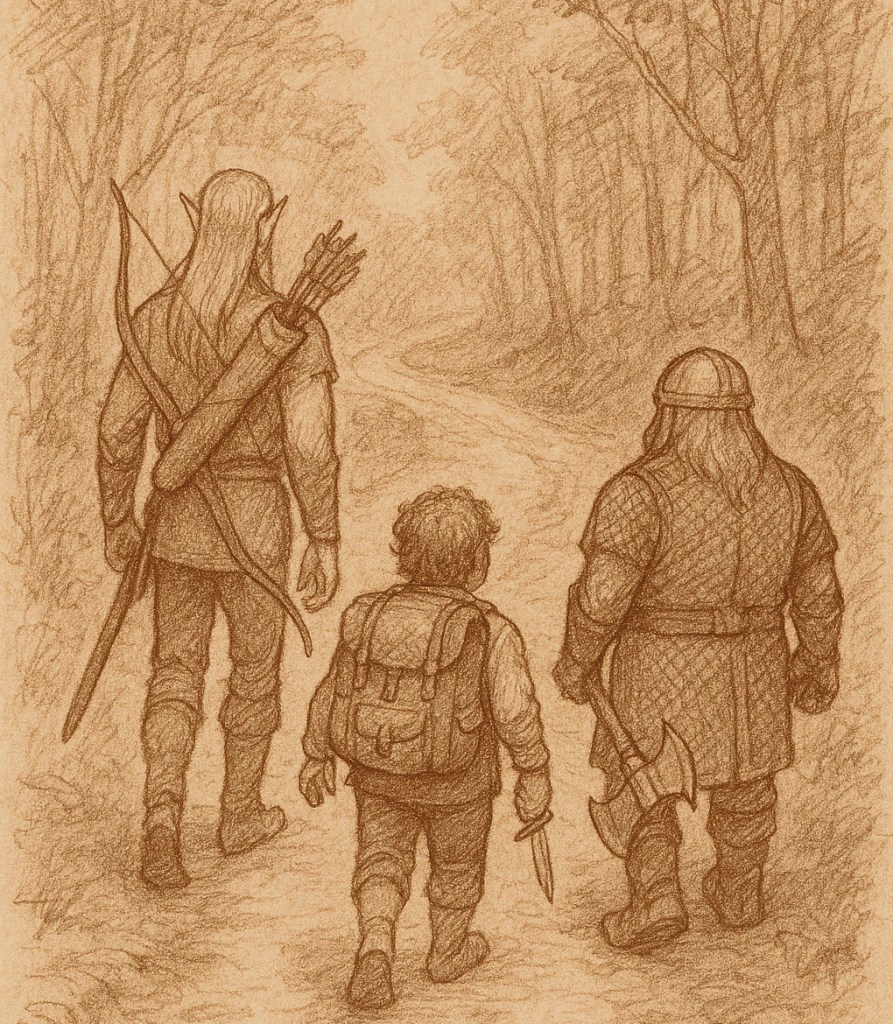
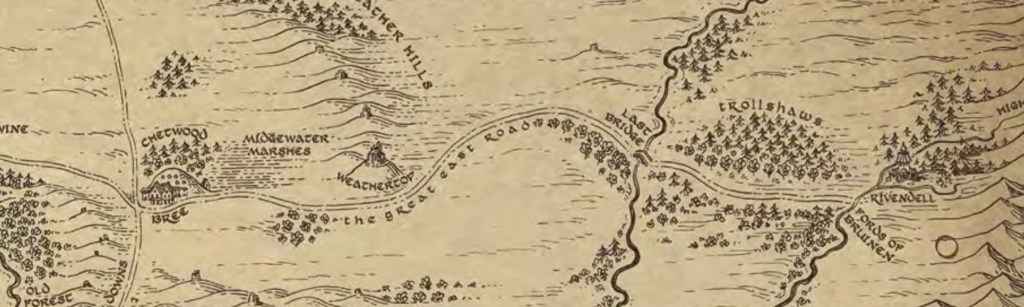
First, Journeys are used when there’s some challenge or danger in reaching the destination. Four hobbits don’t need the Journey rules to skip down to the Green Dragon from Bag End. But if they’re making their way from Bree to Rivendell, they will.
Once a Journey is declared, there are four Roles that must be filled by the party. The Guide is probably the most important and can be filled by only one player. The other three roles: Hunter, Look-out, and Scout are then filled by the other players. If you have fewer than four players, a character can hold more than one role. If you have more than four players, you may have multiple characters in any of those three roles (but not the Guide – there can be only one).
The party then uses a map to identify the route they will take to their destination, making note of the fact that some landmarks, such as mountains and rivers, cannot be easily crossed. The Loremaster (LM) compares their route to the LM map, which has hexes as well as markings for Perilous Areas, and notes any challenges the party is likely to face just based on the route.
So far, no dice have been rolled. Just an agreement on the route they will take and who is fulfilling Journey roles.
Now the Guide will be making Marching Tests by rolling against their Travel skill. This determines how far the party gets before running into some event. Good weather (Spring/Summer) and a highly skilled Guide can get a party pretty far before experiencing an event. You can imagine Aragorn knowing how to avoid certain dangerous areas while Merry and Pippin on their own in Fangorn would have been in dire straights if not for running into Treebeard!
The LM makes note on the hex map where the event will occur. He then rolls to see which other party role (Hunter, Look-out, Scout) is impacted by the event. That role’s key skill (Hunting, Awareness, Explore, respectively) will be tested to determine the outcome, but we still need to determine what the event is. Some are bad, some are good, and the outcome is dependent upon that skill roll.
This is where I got confused and had to consult some LMs on Discord as well as watched some videos. Even then, there was some conflicting information, possibly because of changes in TOR editions and various updates/errata that have been published. Here is my understanding of the rules and how I expect to run it at my table.
With the target of the event selected (Hunter, Look-out, Scout), the LM rolls on an event table to see what happens. Low rolls create negative/harmful events that require a successful roll to avoid. High rolls create positive/beneficial events that are missed on a failed roll.
Make sense? Because it didn’t to me at first.
The bottom line is the target player always wants to roll a success. If the LM roll was low, success means a near hit (I know the term is near miss, but it’s an actual miss dagummits!) – tragedy avoided! If the LM roll was high, success confirms that the player/party achieves the benefit of the event.
My confusion stemmed from the fact that the consequences listed for low rolls only mentioned what happens on a fail. Consequences on a high roll only mentioned what happens on a success. There is no mention of what happens in the opposite case. And, when you look at the events, it seems there really should have been examples.
Take the 8-9 roll that results in a Short Cut event. If the player succeeds, it’s pretty clear they found a short cut and reduced travel time. But if they failed… well, did they find a short cut or didn’t they? If they didn’t, was there really an event? They gained fatigue, so…
Oh, yeah. Fatigue. The act of undergoing a Journey means the members of the party will accumulate Fatigue that is only tallied up at the end of the Journey, when they reach their destination. Almost all of the event types result in Fatigue, no matter whether you succeed or fail.
So, in our failed check on the Short Cut, you didn’t find a short cut, but you gained Fatigue you otherwise wouldn’t have. Why? My understanding is that it is on the LM and the players to develop a suitable story to explain why they thought they had found a short cut but didn’t shorten the journey length and tired themselves out in the process.
Or the Chance-meeting event. If you fail the roll, you get no benefit from the chance meeting. Did you have a chance meeting but it was with someone completely unable to help (or hinder)? Did you just miss out a running into someone? Maybe you found traces of a company of Wood Elves that you just missed by a hair?
And when you succeed on a negative event, like Despair, I think you still have to create a scenario where you could have despaired, but you dug deep and avoided any harm beside the Fatigue gain.
One final aspect of this development of narration to explain the event is that the target role should figure into it. While the Scout may be the one opening new trails, the target role for the event could have been the Hunter. Why did the Hunter figure into the finding of a short cut? That’s something you have to work out on your own.
In any event, once the event is complete, we go back to the Guide for another Marching Test and the cycle continues until you reach your destination. Also, if your route takes you into a Perilous Area (marked on the LM version of the map, such as the Barrow Downs or the Midgewater Marshes), you will have to make some additional event checks.
Once you reach your destination, everyone makes Travel checks to try and shake off some of the accumulated Fatigue. Anyone with a mount may also deduct the mount’s Vigor score. Maybe it’s for ease of managing the Journey, but the accumulated fatigue does not actually impact you during the Journey – only at the end. My guess is they want to avoid a death spiral.
The result is that, following a long Journey, everyone is pretty darn tired and needs to recover. Jumping right into combat is likely to have a very bad outcome. This just feels so right in keeping to the Middle Earth vibe – I do like it. I just wish they took a little more time in the rulebook to illustrate a few examples with both positive and negative events and failed and successful rolls.
The way I see this in play is the entire Journey only takes a few minutes, unless you and your players have a lot of fun narrating the events. It uses some skill checks to add some randomness to it, making a bit of a mini-game, and gives you a chance to make the Journey more than just “You leave Bree and a few days later are looking down into the valley of the Last Homely House.”
Have you used the Journey mechanics? Do they work as I’ve described? Let me know!



 Gypsywagon Gaming
Leave a comment